
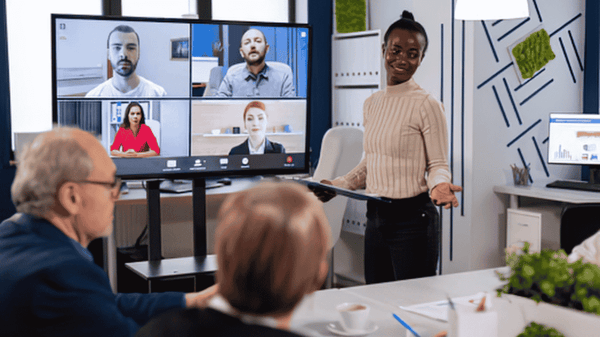
Training teams who are short on time, spread across sites, with uneven skill levels: sound familiar? Blended learning is built for exactly these constraints. It lifts engagement without cutting corners on quality. in 2022–23, almost a third of UK university courses already combined face-to-face teaching with online learning (BBC), and the workplace is moving in the same direction.
But a programme that works is not a video call bolted onto a day in the classroom. It is a deliberate mix, designed around your objectives and your people's constraints. Get that mix right and the results hold up at both small and large scale.
TL;DR
- Blended learning combines in-person and online delivery within a single learning pathway.
- It adds flexibility, personalises learning paths, lifts learner engagement and cuts logistics costs.
- It requires more instructional design work than a standard classroom course.
- How you set up your hybrid models and their settings depends on your learning objectives and your learners' profiles.
- A learning management system (LMS) is the backbone you need to deliver, track and scale a blended programme.
What is blended learning?
Blended learning is an educational approach that combines in-person and online delivery within a single learning pathway. Each type of training — face-to-face, synchronous online or asynchronous online — serves a specific learning objective. Online components can take many forms: e-learning modules, virtual classrooms, microlearning, gamification, MOOCs (Massive Open Online Courses) or SPOCs (Small Private Online Courses). There are no fixed rules on the in-person/online ratio. What matters is the overall consistency of your path.
Blended learning is also called hybrid learning, mixed-mode learning or technology-mediated instruction. The terms overlap, but one distinction is worth keeping straight:
- Blended learning blends in-person and online across a structured pathway, mixing live sessions with self-paced study over time.
- Hybrid learning usually means one live session delivered to two audiences at once: some learners in the room, others joining remotely.
This guide covers blended learning: the approach that most organisations use to upskill their teams.
The benefits of blended learning
Rise Up's 2025 State of Learning Report, which was run with 200 learning professionals, mapped the benefits that L&D (learning and development) leaders and learners attribute to blended learning.
Flexibility and accessibility
Less than 1% of the working week goes into building skills. Blended learning allows every employee to make progress at their own pace, from any location, without stepping away from the job. It removes geographical barriers and levels access, which matters most in multi-site and multi-country organisations.
Personalised learning paths
Digital tools tailor content to each learner's level and profile. Paired with adaptive learning, a blended pathway adjusts its content continuously, based on how far each person has actually progressed.
Stronger engagement
Diversifying the formats keeps a pathway alive and keeps learners' focused. In practice, 83% of L&D leaders rate blended learning as effective, both for engagement and for skills development. In-person sessions carry their own role: the human connection and the live conversations that remote studying cannot reproduce.
Measurable effectiveness
Well-built blended pathways produce results you can put a number on: 95% completion rates, +46% skills retention three months after the course ends, and +93% engagement through personalised course recommendations. At Foncia, 87% of learners finish their blended pathways on Rise Up, across a base of 11,000 learners.
Lower costs
Cutting travel, room rental and on-site logistics frees up budget for better content. Learning impact goes up, fixed costs come down.
The limitations of blended learning
A well-designed blended pathway delivers measurable results. But it would be misleading to present blended learning as a format without trade-offs. Here are the limits to plan for before you start — several of which we cover in more depth in our guide to the pros and cons of blended learning.
More demanding instructional design
Building a blended pathway takes more design work than a standard classroom course. You should not move classroom content into digital learning untouched, especially for asynchronous sequences. Each format has its own codes, its own rhythm and its own storyboarding requirements.
Upskilling for trainers
Running a classroom session and facilitating a virtual classroom call on different skills. Trainers need support through that shift, both on tools and blended training methods.
Learners aren’t always comfortable with digital
Not every employee approaches online learning with the same confidence. Learners who are less familiar with technology can disengage during a remote session if the pathway does not build in the right support.
Equipment and connectivity
An e-learning module that won’t load, a virtual classroom that keeps dropping the signal: technical incidents break the momentum of a pathway. Reliable equipment and a stable connection are a prerequisite, not a detail.
A higher drop-off risk in asynchronous sessions
Asynchronous study offers freedom, but it can also isolate the learner. Without regular interaction and individual follow-up, drop-off rises. Planned touchpoints, such as tutoring, keep engagement going in the long run.
Which models should you choose?
Setting up for your model
Your choice of setup depends on the learning objective, the learner profile and your organisational constraints. Each format has a place in a blended pathway, as long as you use it for what it genuinely adds:
- Self-paced e-learning modules and microlearning for foundational knowledge learners work through independently.
- Virtual classrooms and webinars for live, online sessions (instructor-led training, or ILT, delivered online as VILT — virtual instructor-led training).
- MOOCs and SPOCs (definitions here) for structured online courses at scale.
- Simulations, role-plays and gamified formats to practise in a safe setting.
- Discussion boards and social learning for peer conversation and collaborative learning.
- In-person workshops for hands-on practice and the conversations that need to happen face-to-face.
As a rule, put theory into autonomous, remote study and save in-person time for practice and discussion. The right choice follows the learning objective, not the latest trend.
The main blended learning models
Once the setup is defined, you define the model. The four core models are widely credited to Michael Horn and Heather Staker at the Clayton Christensen Institute:
- Rotation model: learners alternate between formats on a set schedule. It splits into station rotation, lab rotation and individual rotation.
- Flex model: most of the content sits online, with in-person support available on demand.
- A La Carte (or self-blend) model: learners add optional online modules to a common core, chosen to fit their own goals.
- Enriched Virtual model: learners work mainly online, with a set number of mandatory in-person sessions.
Two variations come up often: the flipped classroom, where learners study the theory before class so live time goes to practice, and the online driver model, where online delivery carries the pathway and in-person sessions are the exception. There is no universal ratio: you build the right rhythm around your objectives and constraints.
How to build the right balance between in-person and online
Analyse the needs
Before you pick a modality, identify the skills your organisation is missing. What problem should the training solve, and for whom? A precise diagnosis shapes everything that follows. This is also where you define your audience: getting the right training to the right person is a prerequisite, not an option.
Define the learning objectives and the brief
Learning objectives set out what your learners must be able to do by the end of the pathway. The brief frames the context, constraints, planned content, budget and timeline. It is the reference document that aligns every stakeholder before you start.
Storyboard the pathway
This is the heart of instructional design. Build a logical thread between each block of the pathway. The synopsis sets the overall structure; the storyboard then details each sequence, modality by modality. This step avoids repetition, keeps the pathway coherent end to end and flags the content you need to produce up front.
Create content tailored to each format
Produce content suited to each format: e-learning modules, videos, in-person materials, assessment quizzes. Content built for a classroom does not transfer to digital as-is, especially for asynchronous sequences — a point we unpack in our comparison of e-learning and blended learning. Publish your modules in standard formats such as SCORM or xAPI so your LMS can track them.
Deliver and support learners
The trainer's role shifts in a blended set-up. They no longer just deliver content: they guide, nudge and keep engagement going over time. Regular touchpoints during remote study, such as tutoring, limit the risk of drop-off and build proactive momentum among learners.
Test, measure and scale
Before a large-scale rollout, pilot your programme on a limited group. Measure results: completion rates, learner progress, feedback from the field. Keep what works and adjust what does not. This continuous improvement loop is the difference between a pathway that lasts and one that fades after the first rollout.
Which tools do you need to deploy blended learning?
The LMS as the backbone
A learning management system centralises everything you need to create, deliver and track your teams' training from a single environment. It handles administration, tracks learning paths, generates certificates and reports on results. Without one, running a blended programme at scale is a balancing act.
The authoring tool for content across modalities
A built-in authoring tool allows you to create and update interactive content quickly: videos, quizzes, simulations, SCORM files. It keeps the whole pathway visually and pedagogically consistent, whatever the format. That is a real time-saver for L&D teams producing content for several formats in parallel.
AI and adaptive learning to personalise at scalepersonalized
Generative AI now builds modules in minutes, simplifies complex content and translates pathways into several languages automatically. Adaptive learning adjusts the pathway to each learner's real level and progress, which strengthens skills retention over time. For organisations training large populations across multiple countries, these two levers change what is realistically possible.
A real-world example: Decathlon and Rise Up
Decathlon trains more than 107,000 employees across 85 countries via Decathlon Academy, with Rise Up as its central LMS. Pathways are personalised and content is localised by AI. The results: +42% employee retention, +38% internal promotions and +10% sales growth.
To deploy blended learning at scale, discover Rise Up's LMS platform for blended learning.
Sources: Rise Up 2025 State of Learning ; Jisc, "Beyond Blended".
.jpg?width=460&name=Hubspot%20-%20Featured%20photo%20%20(13).jpg)